
Family life cannot be managed with lists of good intentions. It depends on practical arrangements: who steps in when the primary caregiver reaches their limit, how a child moves from one setting to another without disruption, and what the household actually puts in place to give each family member room to breathe. Supporting children and adults day to day means setting up these arrangements before they are needed.
Parental technoference: when screens interrupt the parent-child relationship
The problem with screens is not limited to the time a child spends in front of a tablet. Santé publique France has identified a less widely discussed phenomenon: parental technoference, meaning interruptions to parent-child interactions caused by an adult’s phone.
A parent who checks notifications during a meal or bedtime story reduces the quality of the interaction without realizing it. The message a young child receives is clear: their parent’s attention is elsewhere. Research highlighted by Santé publique France indicates that this fragmented availability affects the parent-baby relationship just as much as the child’s own screen time.
This shifts the practical focus. Before setting limits on children’s screen use, it helps to look at our own habits during moments spent together. Putting the phone in another room during bath time or dinner is the most direct way to restore uninterrupted parental attention.
Several resources explore this issue from a broader family perspective, including the family section of Maman au Quotidien, which covers everything from young children’s routines to the everyday adjustments of parenting.
Family and community support: building a safety net around the household

A single parent or a couple without nearby family faces a structural problem that household organization alone cannot solve. The Fondation Jean-Jaurès analysis of single-parent families confirms that social isolation can weigh as heavily as financial constraints. A lack of practical support—someone who can pick up a child from school when plans change, or a trusted neighbor who can provide occasional childcare—turns every unexpected event into a crisis.
Building this safety net means identifying the resources available in your area before you need them:
- Community centers and neighborhood centers often offer parenting drop-in sessions, group workshops, and opportunities for families in the same area to connect. These spaces help parents build relationships with others facing similar scheduling challenges.
- Flexible childcare options (daycare centers with extended hours, occasional drop-in childcare, and early childhood support centers) offer flexibility that traditional daycare may not provide. Availability varies by municipality, but finding out what is available in advance can prevent panic when the need arises.
- Local after-school and community activities (sports, music, and recreation centers) also serve as educational support. A child enrolled in a regular activity has a stable setting outside the home, giving parents time to themselves without feeling guilty.
- Informal networks—neighbors, other parents, colleagues—remain the most responsive source of support. Agreeing on a simple arrangement (“I’ll pick up your son on Tuesdays, and you can pick up my daughter on Thursdays”) creates a reciprocal arrangement that can last.
Co-parenting after separation does not automatically provide this respite. The Fondation Jean-Jaurès reports frequent tensions between co-parents and ongoing concerns when a child is with the other parent. Separating childcare arrangements from the feeling of being able to truly take a break helps avoid confusing a shared schedule with effective support.
Children’s screen use: look beyond age-based rules to the social context
Official age-based guidelines (no screens before age 3, limited use until age 6) are widely publicized. Santé publique France offers additional insight: digital habits vary according to parents’ level of education. Families with the least support on this issue also tend to have fewer practical alternatives for keeping a child occupied.
The answer, then, cannot be limited to individual instructions. Media literacy at school, group workshops at libraries or community centers, and free local activities all help redress the balance. A child with access to a sports field, a toy library, or a creative workshop is naturally less reliant on screens to fill their free time.
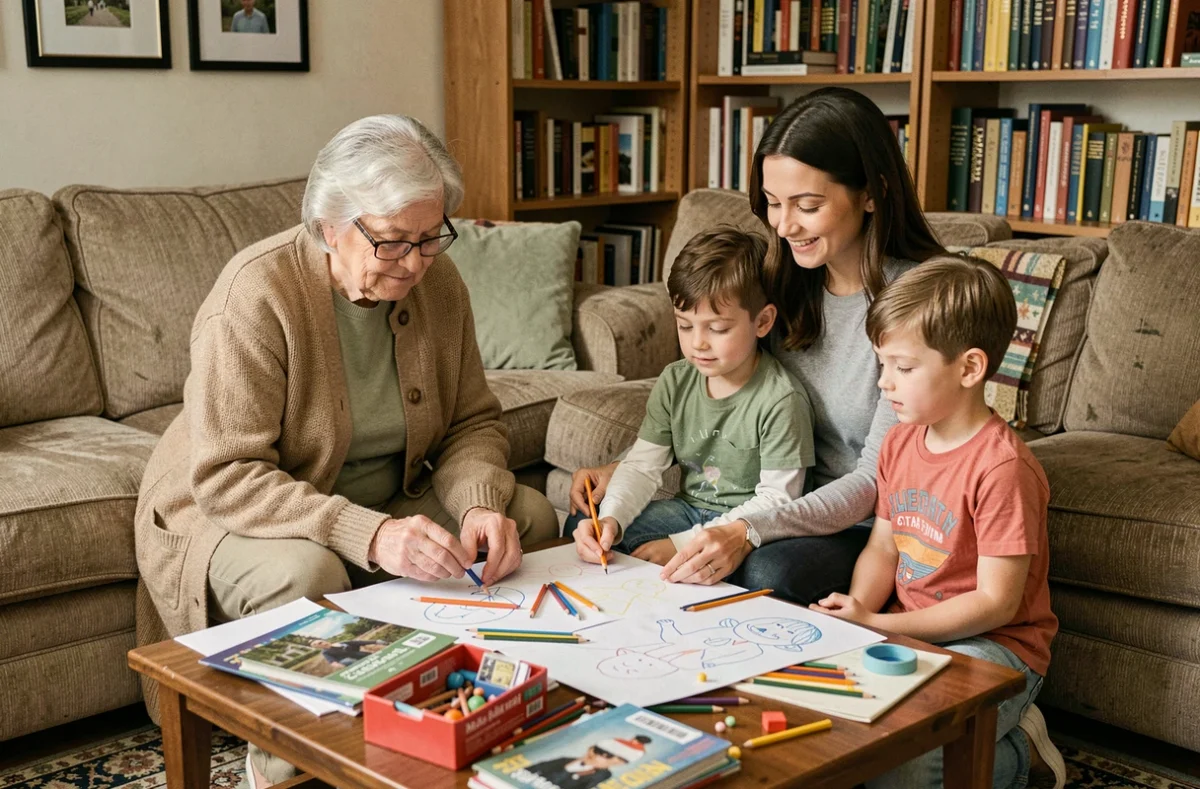
For parents, the most effective approach is to replace screen time rather than simply ban it. Taking away a tablet without offering an alternative leads to conflict. Replacing thirty minutes of screen time with a trip to the park, a board game, or a shared task (cooking, DIY) gradually changes habits without confrontation.
Parental balance: protect a parent’s mental health to protect the child
An exhausted parent may become irritable or overprotective, or gradually disengage. Health and social care professionals emphasize that a child’s well-being depends directly on their parent’s state of mind. Striving to be the perfect parent only accelerates burnout.
Two practical strategies can help protect parents’ well-being. The first is to set aside a non-negotiable weekly slot for the parent alone, even if it is short: an hour’s walk, a personal activity, or time without logistical responsibilities. The second is to explain boundaries to the children themselves. Saying, “I need twenty minutes of quiet,” teaches emotional regulation by example far more effectively than any lecture.
Giving children age-appropriate responsibilities also contributes to this balance. A six-year-old can set the table. A preteen can manage their schoolbag and sports gear. Each task delegated reduces the parent’s mental load while helping the child become more independent, provided expectations are appropriate and consistent.
Family life is built less on principles than on practical arrangements. An identified source of support, a phone left in another room, a personal slot kept free each week: repeated actions like these create a daily routine in which everyone, parents and children alike, has the space they need to keep going over the long term.